Find out how an ABLE account can enhance financial security and provide essential support for those with disabilities.
Do you know how your home is owned and what the legal consequences are? Many people do not realize the impact that the title of your home ownership has on ownership.
This originally aired on the Catholic Faith Network’s show CFN Live: https://youtu.be/dAgoDRJBg5E

The first step is to look at the deed to determine who owns the property and how it is owned. Next, determine what is owned and whether there are any restrictions on the ownership or the property.
What deed ownership is subject to probate?
The most common form of ownership is when someone owns their property outright in their name. For example, Jane owns the property in her name. She owns 100% of the property. In these cases, deeds held in sole ownership are subject to probate. This is because one person owns the property, and when they pass, there is no automatic transfer of ownership.

Another form of ownership is tenants in common. This is where you have multiple owners, and each owns a distinct share or portion of the property. However, all owners have the right to use, possess and enjoy the property. For example, Jane owns the property with her daughter, Katie. As a result, each has a one-half interest in the property.
Similarly, holding real estate as tenants in common will require probate for the deceased owner’s portion. This can create delays and complications for the surviving owners.
Both ownerships would make the property subject to probate on the death of the owner. Probate is the legal process of transferring property after someone passes away, and it can be time-consuming and costly.
Similarly, tenants in common—where multiple people own a property but each has a distinct share—also require probate for the deceased owner’s portion. This can create delays. Additionally, it can create complications for the surviving owners.
What deed ownership options are there to avoid probate?
There are several strategies to avoid probate, and the right one depends on your specific situation.
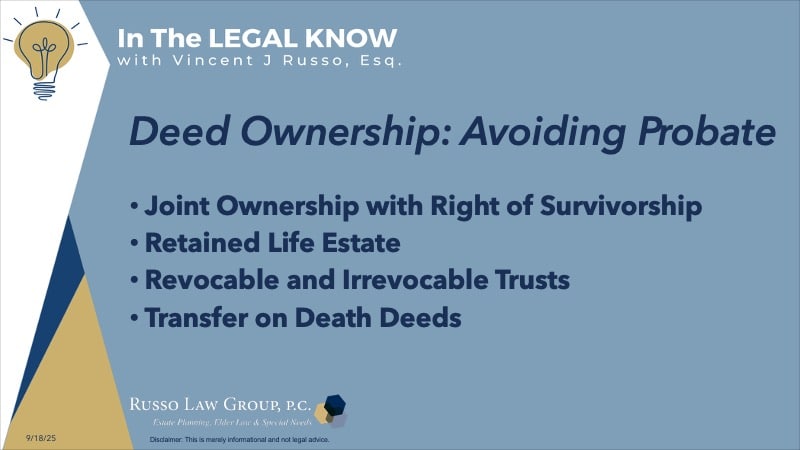
Some common options include:
- Joint ownership with right of survivorship: This allows the property to automatically transfer to the surviving owner without going through probate.
- The biggest advantage is simplicity. However, it can expose you to risks, such as the other owner’s debts or liabilities.
- For example, Jane and her daughter, Katie, could own the property joint with right of survivorship. This would avoid probate on Jane’s demise.
- On the other hand, If Jane were married to Thomas, then there is another type of joint ownership. Tenancy by the entirety which gives additional rights to Jane and Thomas as joint owners.
- Retained life estate: This type of ownership lets you retain the right to live in the property during your lifetime while naming a beneficiary to inherit it after you pass. This avoids probate, but it can limit your ability to sell or refinance the property.
- Revocable and irrevocable trusts: These are powerful tools for avoiding probate and managing your estate. Jane could transfer her ownership to her Revocable Living Trust and avoid probate. She could do the same with an Irrevocable Trust, but she needs to be aware of the potential restrictions in her ownership.
- A revocable living trust offers more control and flexibility. You can manage the property during your lifetime, and it avoids probate after your death. The downside is that it requires proper setup and ongoing maintenance to ensure it works as intended.
- Transfer on death deeds: This type of deed allows you to name a beneficiary who will automatically inherit the property upon your death. Transfer on death deeds are simple and cost-effective Sounds good but there are potential downsides to this type of ownership, and they are not available in every state, so you’ll need to check your local laws.
How does deed ownership work in community property states?
In community property states, property acquired during marriage is owned equally by both spouses. This can simplify things because the property automatically transfers to the surviving spouse in many cases. However, adding a right of survivorship to the deed can ensure that the property avoids probate entirely.
It’s important to consult with an attorney to understand if your property is in a community property state. If so, learn how community property laws apply to your situation.
What factors should people consider when choosing a deed ownership option?
There are three key factors to consider:

- Marital Status: If you’re married, joint ownership might make sense, but if you’re single, a trust might be a better fit.
- Liability: Some options, like joint ownership, can expose you to the other owner’s debts, while others, like trusts, can offer protection.
- Estate Planning Goals: If your goal is to avoid probate and ensure a smooth transfer of property, the trust option might be ideal.
What are the tax implications of deed ownership?
The way you hold title to your property can affect capital gains taxes, estate taxes, and even property taxes.

- Property Taxes: Qualifying for exemptions such as a senior or veterans’ exemption can be impacted on how title is held to your primary residence. Also, some transfers, like those involving trusts or lifetime gifting, can trigger reassessments of property taxes, depending on your state’s laws. This could result in higher property taxes for the new owner.”
- Capital Gains Taxes: If you transfer property during your lifetime, such as through lifetime gifting, the recipient inherits your cost basis. This means if they sell the property later, they could face significant capital gains taxes on the appreciation.
- For example, if you bought a property for $100,000 and it’s now worth $500,000, the recipient would pay taxes on the $400,000 gain.
- However, if the property is transferred at death, the beneficiary typically gets a step-up in basis. This means the property’s value is reset to its fair market value at the time of your death, potentially eliminating capital gains taxes.
- If your home is your primary residence, then you may be entitled to a capital gain tax exclusion of $250,000 or $500,000 if married.
- Estate Taxes: For high-net-worth individuals, estate taxes can be a concern. Certain ownership structures, like irrevocable trusts, can help reduce the taxable value of your estate, potentially saving your heirs a significant amount of money.
How does deed ownership impact qualifying for Medicaid long term care?
Medicaid is a government program that helps cover long-term care costs. However, eligibility is based on your income and assets. The way you own property can affect your eligibility.
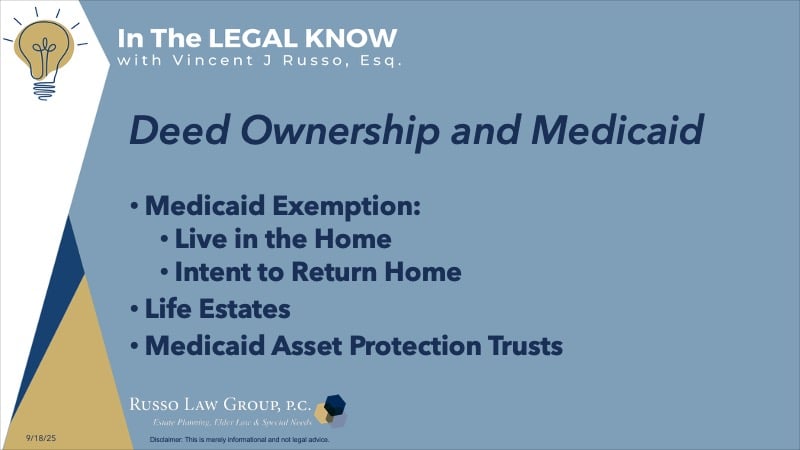
- Homestead Exemption: Your home will not be counted for Medicaid qualification if you live in the residence or have an intent to return home (subject to State law). Notwithstanding, the home is not exempt from a Medicaid estate recovery (with certain exceptions).
- Irrevocable Trusts: One of the most effective tools for Medicaid planning is an irrevocable trust (the “Medicaid Asset Protection Trust”). By transferring your property into an irrevocable trust, it’s no longer considered part of your assets for Medicaid purposes. If one is applying for nursing home care, the transfer to the trust needs to be five years before applying for Medicaid. This is known as the Medicaid look-back period.
- Retained Life Estate: Another option is a retained life estate, where you transfer ownership of the property to a beneficiary but retain the right to live in it for the rest of your life. This can help protect the property from Medicaid recovery after your death. But it must also comply with the five-year look-back period for nursing home care.
- Joint Ownership: Adding a joint owner to your deed can sometimes protect the property from Medicaid recovery, but it is not always the best option. For example, if the joint owner is not your spouse, it could create complications for Medicaid eligibility or expose the property to their creditors.
- Lifetime Gifting: Gifting the property outright can also remove it from your assets, but it comes with risks, such as losing control over the property and potential tax consequences for the recipient.
CLICK HERE for our complimentary Planning Guides.
If you would like to speak with an experienced elder law attorney regarding your situation or have questions about something you have read, please do not hesitate to contact our office at 1 (800) 680-1717. We look forward to the opportunity to work with you.
Disclaimer: The information provided above is for general informational purposes only and is not legal advice.

Related Posts

Comments (0)